

The Luck of Ivan the Forgetful
by Nemirovich-Danchenko, V. I.XI
The forest was brilliant in white apparel. Under the wintry veil its creative forces slumbered. Not a tree-top swayed, nor a branch stirred. The sky was covered with grey clouds and the earth with snow, which in the stillness gave out a light crackling sound under Anjuta’s feet. She tried once or twice to sing, but the grim silence of the primeval pines sobered her with a sense of weird mystery. She tried to tread as lightly as possible in order not to awake the gloomy trees on the right and left out of their slumbers.
What might not be hidden under these snow-laden branches which almost touched the ground? How terrible it would be if “it” suddenly crept out without a sound. The fact that she could not define to herself what the “it” was, made it all the more formidable.
And now she heard a low moaning at the bottom of the ravine. Perhaps it was the brook, but if…? She did not think the thought out, but hastened forward, stumbling and gliding. She looked attentively for the axe-notches in the tree-trunks in order not to lose her way. She also saw the sign of the cross on the birch half obliterated with snow.
The child sat on a snow-heap, and looked at the cross for the first time attentively. Round about were visible what looked like footprints in the snow. Were they caused by the wind, or——? An icy shudder ran through her; fortunately it occurred to her that “they” had no power by day, and only went about in the darkness. Yes, of course it was “they.”
How often had her mother, whom her Grandfather had buried in the forest, told her that the souls of unbaptized children roamed about by night. When such a child dies, the Lord does not take it to Himself. “You do not belong to Me,” He says. Woe betide the unlucky person who meets one of “them.” It weeps and sobs pitiably, but if one takes it up, it seizes one’s throat with its teeth.
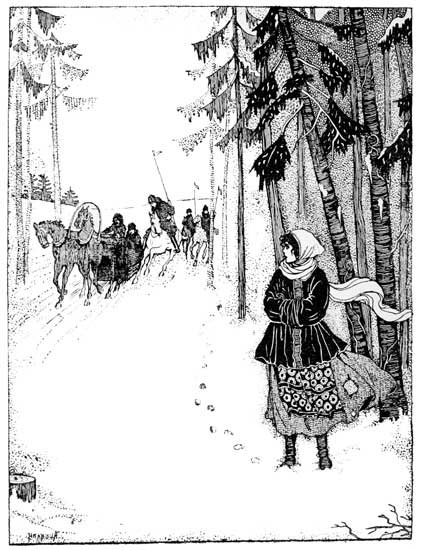
Anjuta sprang up and went quickly on. Again the enchanted silence surrounded her, again the lofty motionless trees looked at her as though they were astonished at the little intruder who disturbed their icy winter sleep. Anjuta became hungry and gnawed at a dry crust of bread as she went along; at the same time she was so absorbed in her thoughts that she stumbled. She looked around; there before her spread a white plain with the chimneys of the poverty-stricken little village in the background. Behind her rose the dark stiff wall of the wood. The main road ran close up to it and then, as though in sudden alarm, turned sharply to one side.
Anjuta felt that for nothing in the world would she go back alone. The wood from which she had happily emerged inspired her afterwards with such fear, that she began to run, and sped over the snowy plain like an arrow. A strange sight brought her to a standstill. Four riders with long lances in their hands and guns slung across their backs rode by the side of a sledge, in which sat a stout man. He looked very grand, with his high turned-up fur collar and a cap with a red band round it. She had only once seen such a fine gentleman before, when she was begging with her mother in the town. The joyful consciousness of having the wood happily behind her so braced her up, that she felt no embarrassment before the stranger.
“Listen, child!” the stout gentleman said to her. “Where have you come from?”
“From the wood, Uncle.”
“How is that possible? Do people live there?”
“Only Grandfather and I.”
“Do you belong to the village?”
“No. Grandfather has come from far away, and he found me in the wood, when my mother had died.”
“Wait, wait,” exclaimed the man in the sledge, who seemed struck with a new idea. “They said there,” he pointed to the village, “that he had not been seen in this neighbourhood. Of course, you don’t know your grandfather’s name; how should you?”
“Yes, I know it quite well,” she laughed. “It is Ivan.”
“Ah, but he did not tell you what other name he had. That ought to have occurred to him.”
“Yes, but he did,” said the child merrily. “And I remember it well.”
“You are joking.”
“He is called Ivan the Runaway. That’s it. And my name is Anjuta.”
“That’s just the man we want,” laughed the official with great satisfaction. “Look out, you rascals”—he made a threatening gesture towards the village—”you shelter escaped convicts. Where is your grandfather?”
“He is in bed.”
“What? Out there in the wood?”
“Yes; he is ill since the bear attacked him. He can hardly crawl round our hut.”
“Ah! then he can’t run away.”
“Why should he run away?” laughed Anjuta. “He is waiting for me. I am going to the village,” she added with an air of importance, “to buy bread and meal.”
“Well, listen now. Sit here by my side. Would you like to help your grandfather? We will make him well and give him bread and money, so that he can live without anxiety.”
“Yes, but Grandfather wanted to make a hole under the earth for us both, because it is so terribly cold in the forest.”
“Very well; we will build him a strong hut.”
“With a real fire-place like Lasaref has?”
“Yes, just like that.”
The little girl clapped her hands in glee. “And I will always cook him good broth. That is just what Grandfather has always told me, that one should help the other, and then God helps all.”
“Yes, certainly. We will help him too.”
Anjuta clambered up on the box-seat. The peasant who held the reins gave her a violent dig in the side and angrily hissed between his teeth, “Stupid goose!”
“Stephan,” said the stout official, “can the sledge go through the wood?”
“No,” was the sulky reply.
“Ah, but when you get something on your obstinate neck it can. Turn round, rascal! In winter one can go everywhere.”
Anjuta had become quite silent. Why was the kind gentleman so angry all of a sudden? The sledge had already reached the wood.
“How pleased Grandfather will be!” she thought, and smiled again her happy childish smile.