
Ukrainian Authors: Marko Vovchok
The stifling bureaucratic regime of Nicholas I offered a poor opportunity for the development of a new generation. The collapse of the Society of Saints Cyril and Methodius was a heavy blow to the older school of Ukrainian authors and it weighed still more heavily upon the next generation which would have been attracted to it. At the same time throughout Russia the old Romantic school vanished and a new era of prose came into being. It was now the period of Turgenev and Belinsky and it was only natural that the new tendencies would make their influence felt upon the still weak Ukrainian literature.
There was another factor that was extremely important. Up to this time the authors had had a personal connection with the old Ukraine in its last phases. Shevchenko knew from his grandfather many details of the Koliivshchina. In his youth there were still living men and women who remembered that revolt, the Sich and the Hetman state. What would be the spirit of the writers who had been born too late to have that personal contact with the actors of the last scenes? That question was still to be answered.
By the time that Alexander II had ascended the throne, Russia and all Europe had passed out of the Romantic period. The new school of writing paid attention not to the past but to the present, to the hardships and difficulties of daily life rather than to the stirring deeds of even the recent past. This was particularly true in Russia where for nearly half a century all the writers devoted themselves exclusively to the contemporary scene and to the movement for the liberation of the peasants and the improvement of the conditions of the present.
Kvitka had in a way directed the attention of the Ukrainian authors to the rich stores of material that were to be found there but his characters were too idealized, too perfect to suit the next generation. Besides that the predominant idea may well be called the belief in the republican philosopher in homespun. The type appeared in France, in England, in America, and in Russia and of course it would appear in Ukraine. This was a school of thought that definitely emphasized the humanity and the clear thinking of the uneducated peasant. The authors believed sincerely that most, if not all of the evil of life, came from the misthinking and errors of the upper classes. They saw in the peasants, despite their rudeness, a vigor and an intelligence that only required the possibility of free use and development to solve most of the troubles and abuses of the day.
And those abuses were heavy. The rights of the nobles were construed so as to deny to the peasants the most elementary human rights and the serfs in Russia were probably never more bitterly oppressed than they were in the last decades of serfdom. The economic pressure of progress upon the nobles was so great that many of them, to satisfy their supposed financial needs and to keep up with the procession of culture, found it necessary to squeeze the last drop of income out of their serfs and the more the landowners desired the comforts of the nineteenth century, the more they were forced to inhuman devices to collect the wherewithal.
Shevchenko in his last works keenly felt this oppression. He had passed through the school of experience and after he had been able to compare the life in the capital with the hardships of the peasants, he spoke out strongly against this oppression. His was not the only voice that was raised but it carried him over from the Romantic period to the age of realism.
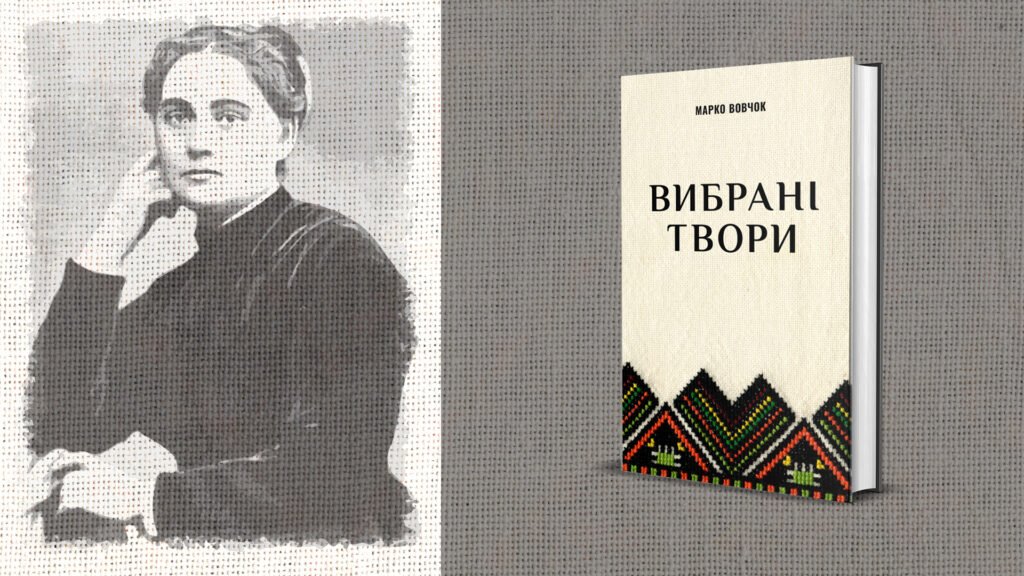
The author that was to be the spokesman of this new period in prose was Maria Vilinskaya, who was born in 1834 of a Ukrainian landowning family which had moved from Ukraine to Orel in Russia. She was educated in the Kharkiv pension, one of the fashionable girl’s schools of the period. When she returned to Orel, she met and married Opanas Markovich, who was there in exile as a former member of the Society of Saints Cyril and Methodius. The newly married couple returned to Ukraine in 1851 and for about a decade they lived in Chernihiv, Kiev, and Nemiriv. She became interested in ethnography and began to study the peasant life, customs, and language. Naturally the young wife became convinced of the evils of serfdom and it was this that launched her into literature.
In 1852 Turgenev had published in book form his Memoirs of a Sportsman and these tales of peasant life speedily became the standard for the new realistic treatment of the peasant existence. The Tsar Alexander II read and reread them and it was often said that they inspired him to issue the decree of emancipation. Yet it is to be noted that Turgenev had contented himself with picturing the peasants as human beings and had not laid stress upon those phases of life that were most repulsive to the human conscience. He had secured his effects by emphasizing the humanity of the peasants rather than the brutality of the landowners and thereby he had definitely reached the higher level of literature which many of his followers failed to attain.
In 1857 Maria Markovich sent to Kulish two stories on Ukrainian peasant life which he read with enthusiasm and published under the pen name of Marko Vovchok. The real identity of the author was not ascertained for some time but the stories themselves attracted a great deal of attention as soon as they were published. The next year, 1858, a full volume appeared under the title of Narodni Opovidaniya (Folk Sketches) and it was warmly acclaimed by Shevchenko as the writing of a prophet sent to the Ukrainian people to rouse them to opposition against serfdom. Turgenev translated some of these tales into Russian and Maria Markovich soon finished the translation herself.
She soon published another series in Russian under the title of Stories from the Folk Life of Russia which attracted attention. The Russian critic Dobrolyubov used this latter work as a text for one of his longer essays on the real strength of the peasant character, after he had criticized her Ukrainian works on the ground that it was impossible and undesirable socially to endeavor to create a literary vocabulary in what was essentially an uncouth peasant dialect, an idea which he stoutly maintained along with most of the Russian radicals and a large part of the reactionary bureaucracy.
In 1859 she and her husband went abroad and while she was away she published in 1862 another volume of Ukrainian stories. He returned to Russia without her and died in 1867. During these years she became very friendly with the radical leaders Herzen, Ogaryev, and Bakunin, and from this time on she practically ceased to write in Ukrainian. Later she married again and shortly before her death in 1907 brought out a few more stories but apparently most of these had been written during the few years when she was active.
Yet her fame really rests upon her stories in Ukrainian. As in the case of Kvitka, her Russian works were really mediocre and this is the more remarkable as Ukrainian was probably not really the language spoken in her family. So striking is her mastery of Ukrainian in these days that many critics have believed that the role of her husband in their production was greater than has been often supposed.
The appearance of the first volume of her Ukrainian Sketches was the sensation of the year and they added to the overwhelming disgust at serfdom which was growing among all thinking classes of society. Their one theme was the abominable way in which the serfs were treated and she emphasized especially the hard lot of the women who were thwarted by the cruelty of the masters in their desires to lead a normal, decent existence. In this they agree in style with the Memoirs of a Sportsman by Turgenev but they differ in that Marko Vovchok does not hesitate to present shocking examples of the abuse of the peasants by their masters, instead of merely indicating the humanity of the peasants. Thus in Horpina the peasants are compelled to work three days on their master’s estates for him, two days for the poll tax, and the fifth and sixth days for grinding grain, and the young master drives his people harder than he does his cattle.
In the same story the mother takes a sick child to work in the fields with her, because there is no one in the village to care for it, and the master orders the overseer to take the child back and leave it alone in her empty house, because she takes time from her labor to look after it. In order to stop the child from crying, while it is alone, she gives it an opiate. When the child dies as a result, the mother from a sense of guilt goes insane.
Marko Vovchok does not hesitate to draw such stories of the callousness of the masters and to emphasize the differences between the small free proprietors and the serfs. Thus in the Kozak Woman, the girl Olesya is the daughter of a wealthy farmer but she falls in love with Ivan Zolotarenko, a serf. The leaders of the village express their opposition to this union of a free woman and a serf but she insists and submits to bondage for his sake. She spends all her money and sinks down to the level of her companions. Then her husband is taken away to the city by his master and dies there. At this moment she neglects to recover her freedom because of her children and almost at once her oldest son is taken away to serve as a companion and servant to the son of the master. He fails to make good and dies. When she too passes away, the master of the estate is even unwilling to bury her and the expense of this is left to the already over-burdened serfs, who have that sense of decency which is lacking in the master, a Russianized Pole.
In the Institutka, we have another picture of a cruel and abusive woman who has received the best education that her family can give her and who returns from school only to abuse her mother and to wreak her vengeance on every one that crosses her, including her husband and her peasants. It is a lurid story of human meanness which spares no one. The story is told by a peasant woman Ustina, a maid of the Institutka, who has seen her husband forced into the army for a long term of years because he had endeavored to protect her when she was being unjustly flogged. Ustina is compelled to go to the city and work as a servant but even this is preferable to life on the old estate under the iron hand of the inhuman mistress.
Marko Vovchok’s understanding of the emotions and the feelings of the peasant women struck a new note in Ukrainian and Russian literature. Her feminine instincts told her how they reacted to the hardships of their lives and perhaps no author has better expressed the disastrous effects of serfdom upon the women who suffered from it and the women who profited by it.
In addition to these tales of human suffering and brutality, she also wrote a number, setting out in narrative form some of the Ukrainian folktales and superstitions. Thus in the Chary, (the Charms) a sorceress succeeds in changing her rival into a bird and marrying the abandoned husband. Later when the bird returns to the old home, she persuades her innocent husband to shoot it and the dying bird changes back into the wife. The story is told simply and the author succeeds in imparting to it that unreal atmosphere that makes us regard it as a real event.
So too in Lemerivna. A rich, young Kozak loves a girl and woos her. The girl refuses to love him in return but her mother, who is mindful of the qualities of the young man, finally forces her into the wedding. After it is over and he starts with her for her new home, she commits suicide and he goes off and is never heard of again.
Marko Vovchok is easily the outstanding prose writer of her period, the age just before the liberation of the serfs. She was one of the group that cooperated in producing the state of mind that reformed the evil and deserves all credit for it. It is only a pity and a great loss to Ukrainian literature that she gave it up almost as soon as she had achieved success. She was another of those talents that were so frequent in Russian Ukraine who were swept from the vernacular literature of the land into the colossal sea of Russian and who then never justified their work, either by the quality of their productions or the benefit that they may have hoped to give to the people.
By Clarence A. Manning
From his book
Ukrainian Literature,
Studies of the Leading Authors
1944