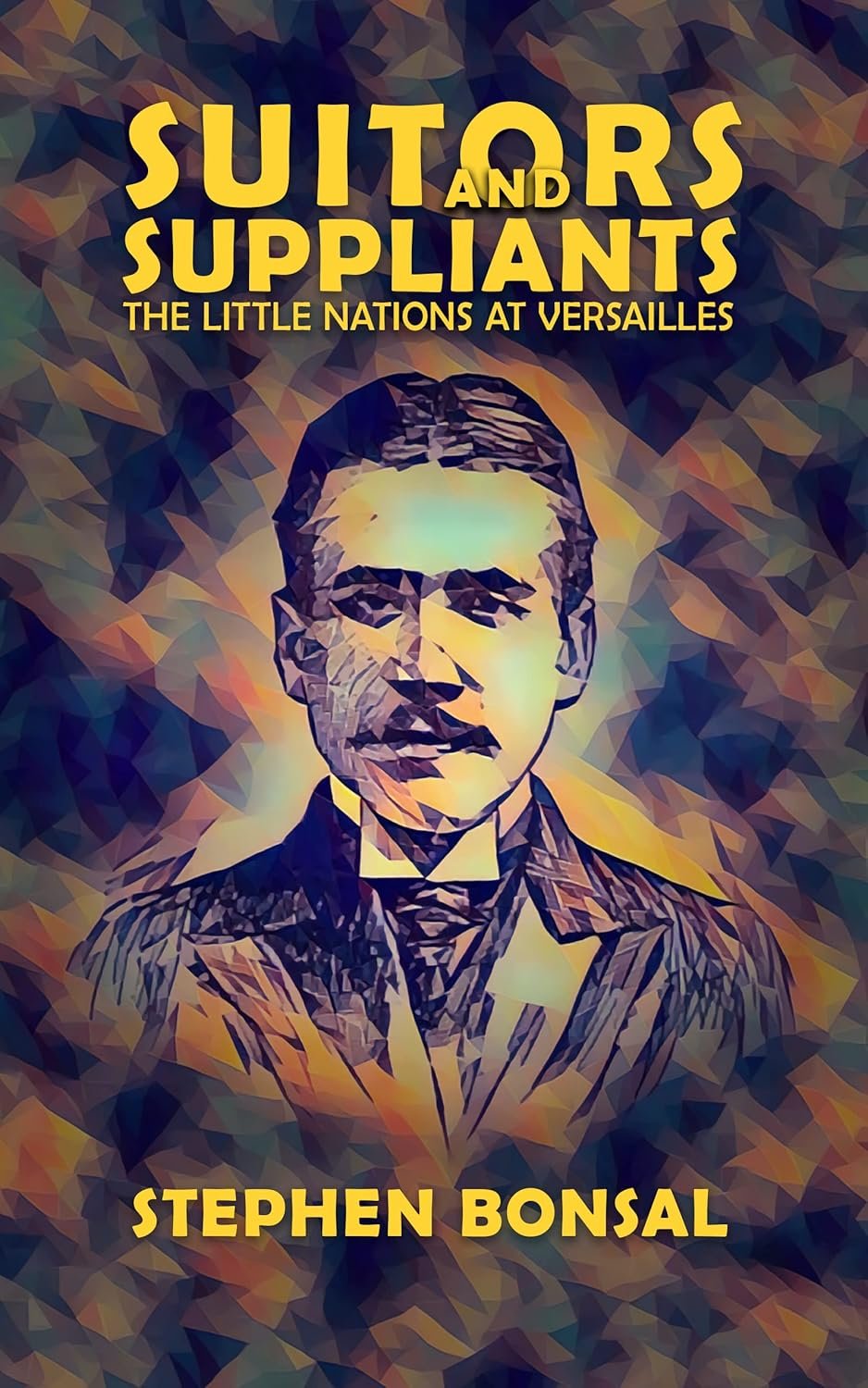
Bonsal, Stephen
Stories
2
Chapters
256
Words
242.3 K
Comments
0
Reading
20 h, 11 m
 “Whither then are you speeding, Russia of mine?” asked Gogol in 1841. I quote him and shall endeavor to give some of the very contradictory answers that are given me here today. The Russian groups are sweeping down upon me in ever-increasing numbers. I give them a loose rein, and after they have delivered themselves of what they have to say, more or less exhausted they retire. I remain silent. I am at the receiving end, but when I have to say something, I confine my words to the President’s…
- 113.7 K • Completed
- When Kerensky called today, I took this opportunity of relating to him an episode of my war days in Russia. It proved far from comforting and added to his burden of doubt and anxiety which, despite his brave words, is evidently very heavy. In November, 1915, I traveled through Russia on my way back to my post in the Philippines. The English, for war purposes, had bought up all the trans-Pacific liners, and so I was compelled to proceed to the Far East by an unusual route, through war-stricken Europe.…
- 113.7 K • Completed
- Suddenly in the hour of victory the President has changed his mind as to where the Peace Conference should be held. He had hitherto openly, indeed even boisterously, favored Lausanne, Geneva, any place in Switzerland. But now he vetoes all these places and plunges for Paris. “In Switzerland,” he cables, “the Conference would be saturated by every poisonous element and very accessible to hostile influences.” House is amazed and not a little disappointed. He was against Paris as the meeting place;…
- 113.7 K • Completed
- Colonel House treated us to a bit of acting this morning, which left Frazier and myself abashed and ashamed of our own poor performances. At what seemed to us the crack of dawn, although it was really after eight, General Mordacq appeared. He is the principal military aid of the Tiger; he wore the formal uniform of great occasions and was covered with decorations, and his mien was portentous. “I have come to tell you, at the express orders of the president of the Council of Ministers, that the armistice…
- 113.7 K • Completed
- Here is Colonel Boyd’s version as to what really happened, and he ought to know because he is Pershing’s brilliant military secretary and interprets for him in all his contacts with French officials. Of course, Black Jack wanted to push on to Berlin, as did every soldier in the army, but at the Senlis Conference on October 25 he agreed with Haig and Petain and Bliss that if the Germans asked for an armistice the terms we had agreed upon must be submitted to them. They were, none of them, enthusiastic…
- 113.7 K • Completed
- A very momentous meeting chez House this morning. Everybody was there, but Foch, the Generalissimo, had the floor and did not seem inclined to share time with any of the civilian chiefs. Lloyd George remarked in a petulant aside, “I think we are wasting precious hours. The Germans are beaten but not down on their knees as yet. They are not thinking of surrender.” If Foch heard this, he paid no attention to it. He described at considerable length the operations that he was planning, that were indeed…
- 113.7 K • Completed
- House received his credentials at the White House on October the fourteenth (1918). Several days before that, aware of the mission upon which he was about to set out and impressed with the fact from the day that the Bulgars capitulated to the Army of the East (September 29th) that more local knowledge was needed than he possessed, he sent a cable to Pershing asking that someone familiar with Balkan conditions be attached to his staff. This cable resulted in my recall from the 26th Division and my being…
- 113.7 K • Completed
- In the gray light of a misty morning, I had my last glimpse in wartime of the Verdun salient and of the shell-pitted route which had proved to be the life line of France. There were many fires glowing in the beleaguered city, but outside in the shadows the graveyard of half-a-million unburied Germans and as many gallant sons of France was veiled in a heavy mist. Overhead many invisible planes were droning about upon their deadly missions, and the roar of the never-ceasing bombardment made all conversation…
- 113.7 K • Completed
- In the following section of my chronicle of things seen and heard at the Peace Conference, I have in pursuit of clarity, an ideal so often praised by our French friends, withdrawn from the body of my diary many entries dealing with issues with which in my subordinate capacity I was closely concerned or which for a variety of reasons were of special interest to me. Also, in order to present in as straightforward and lucid a manner as possible the complex pleas of the many suitors and suppliants at the bar…
- 113.7 K • Completed
- The causes of war vary in detail, although in most instances they have their source in the expansionist policies of a nation of people on the make, or in the determination of a fading power to hold what it acquired when it was young and strong and relatively virtuous. Nations in the first category which have made war have usually been egged on to it by a chorus of ancestral voices both jingo and traditional—of whom Wagner and Hegel are good examples—and this cultural voodoo has usually evoked an…
- 113.7 K • Completed
- Previous 1 … 14 15 16 … 26 Next