

Pushkin: His Works
Bielinsky’s weighty articles, written between 1843 and 1846, remain to this day the sole exhaustive review of Poushkin’s poems, and continue to form the basis of all close analysis of his work. But even these criticisms are lacking in the complete insight which comes of biographical research.
For many years after Poushkin’s death the suspicion which still attached to his name, and the close censorship exercised over the publication of his literary remains, proved hindrances to the preparation of a complete biography of the poet. His life had to be largely compiled from hearsay, and when the first instalment of it appeared — which was not until twenty years after his death — it did not do much to elucidate certain matters which could not be safely handled even at that distance of time. To analyse his poetry in the light of biographical facts remained for years an impossibility, therefore Bielinsky’s review of Poushkin’s life-work is complete only from the purely aesthetic side. When at last the inner life of the man was revealed to the world, his moods, theories, and social views, public opinion was sharply divided, and every section of a disunited society strove to claim Poushkin as its own. He was hailed in turn as the defender of tradition, as the champion of social liberty, as the high-priest of pure art, as the founder of modern realism. And owing to the complexity of Poushkin’s nature, these apparently irreconcilable claims have all some foundation of reason. Poushkin was essentially the child of his country and of his age, in whom were reflected all the varying shades of thought and emotion with which he was surrounded. Spassovich compares Poushkin’s genius to a placid sheet of water, the surface of which is broken into circles that touch and interlink, each of these rings representing some sphere of external influence which widens and vanishes as it grows more remote from its centre. But Spassovich does not sufficiently realise that these reticulations were mainly superficial and scarcely disturbed the actual depths of Poushkin’s individuality.
The poems dating from his schooldays, and the early satirical or “pamphlet” verses, are chiefly interesting as showing the extraordinary rapidity of his intellectual growth, and the care which, from the first, he bestowed upon the technical side of his art. We discern the influence of Joukovsky in the romantic colouring of some of these juvenile poems, and that of Batioushkov in the chiselled excellence of their workmanship. “Though they have not the quality of Byron’s ‘Hours of Idleness,”‘says Bielinsky, “they astonish us by their elegance and felicity.” In the verses entitled “To my comrades on leaving school,” we find this lad of sixteen striving already after novelty of rhyme and rhythm, and venturing to use the simplest words, when they served his purpose, in preference to the insipid euphemisms of the pseudo-classical school. The popularity of his witty and epigrammatic verses was extraordinary, even at a period when that kind of anonymous literature was a feature of social life. “At that time,” says a contemporary, “there was not a single ensign in the army, however illiterate, who did not know these verses by heart. Poushkin was the echo of his generation with all its faults and virtues.”
The political extravagances of Poushkin’s youth have been severely censured by some of his critics. Pypin, whose opinions are almost invariably just, because based upon a wide historical outlook, reminds us that his instability and lack of definite social convictions were the natural outcome of that period of unrest, when even Alexander I himself was carried away, first by Western liberalism and afterwards by the general reaction. One thing may be said in favour of Poushkin’s satire: it was nearly always directed against what was actually injurious to society, and never used as the weapon of mere personal spite.
Upon the political verses followed a group of transitional poems, in which the influence of his Russian precursors is perceptibly on the wane, and that of Byron claims the ascendancy. One of the first indications of this phase is shown in a short poem, “The Black Shawl,” a Moldavian song which the poet overheard in a tavern at Kishiniev, and afterwards adapted to his own fancy, infusing into it a drop of the true Byronic essence. Since this poem marks the starting- point of a new departure in Poushkin’s career, I avail myself of Professor Morfill’s kind permission to reprint his translation of it among the examples at the close of this chapter.
In The Prisoner in the Caucasus Spassovich sees “The Corsair” in another dress. But even this early poem, written at a time when Poushkin’s admiration for Byron was in its most ardent and uncritical stage, marks the essential difference between the temperaments of the two poets. Poushkin’s hero has far less of the self-centred, savage misanthropy of the Corsair; his dissatisfaction with society turns to brooding melancholy rather than to fierce protest. Speaking of this work in later life, Poushkin said, “It contains the verses of my heart,” but his artistic judgment condemned it in his maturity.
The Fountain of Bakchisarai (1822) shows a steady advance in individuality, and when we come to The Gipsies (1824) and Poltava (1828), the difference in method and sentiment between master and disciple is distinctly noticeable. Aleko, the hero of The Gipsies, belongs to the picturesque type of social outcast who figures again and again in the works of both Byron and Poushkin. But Poushkin was already outgrowing the sombre self-sufficiency which made Byron pose as the leading character in most of his romantic poems. The Russian poet now began to regard his creation from an objective standpoint, sometimes even from a critical one. Byron, we feel sure, was in fullest sympathy with Conrad, Lara, and the Giaour; but when Poushkin puts into the mouth of the old gipsy leader his dignified reproof to the guest who has brought discord and bloodshed into the free and simple life of the caravan, we suspect that it is the poet himself who is criticising Aleko’s unprofitable egoism. The Gipsies marks the second phase of Poushkin’s worship of Byron.
A further stage of independent development is reached in Poltava which some critics rank as Poushkin’s finest achievement. The poem shares the same subject as Byron’s “Mazeppa,” but here the difference of treatment is not only due to temperamental causes, but also to a widely different historical point of view. While Byron founded his poem on a passage from Voltaire’s History of Charles XII, Poushkin had recourse to national tradition; consequently his poem gains in convincing realism, although losing something in romantic glamour. Poushkin’s Hetman of Cossacks is a rapacious, cunning, brutal soldier of fortune, scarcely a hero in any sense of the word. But the true hero of Poltava is not Mazeppa, but Peter the Great, whose character had an intense fascination for Poushkin, and to whose memory he dedicated one of the most powerful and polished of his poems, “The Bronze Horseman.”
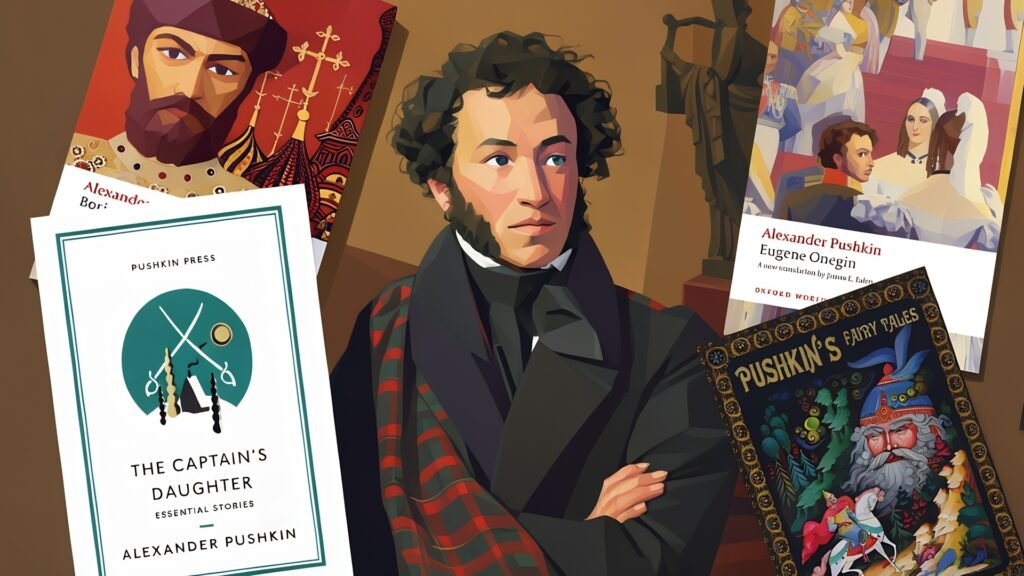
In none of Poushkin’s works, however, can we trace his gradual emancipation from Byron’s influence, and his steady progress towards independence and nationality, so clearly as in Eugene Oniegin. This, the most popular of his poems, also engaged his thoughts for the longest period; being, in fact, a kind of confession, or autobiographical record, extending over seven years of his life. In 1823 Poushkin wrote to Prince Viazemsky, that he had begun a novel in verse in the style of “Don Juan,” and in his preface to the first chapter, published in 1825, he says that the opening of his work will recall “‘Beppo,’ the facetious work of the gloomy Byron.” But a year later he had left all thought of imitation so far behind that he indignantly denied any connection between Oniegin and “Beppo” or “Don Juan.” The subject of the poem is drawn from contemporary life, and the design is simple to the verge of naïveté. The scene is laid in the heart of rural Russia. The first chapter introduces Madame Lerin and her daughters, Tatiana and Olga, who, as I have already related, were undoubtedly sketched from the sisters Wulf, and the old servant, Nurse Philipievna, the original of whom may have been Arina Rodionova.
Tatiana, an inexperienced, country-bred girl, falls in love with Eugene Oniegin, a disenchanted, world-weary rake who, somewhat against his will, is spending a few weeks in the neighbourhood with his friend Lensky, a sensitive, passionate youth, fresh from a German university. Lensky’s tender but rather morbid temperament is at once the foil and the complement of the cold-blooded, egotistical Oniegin. So, too, Tatiana and her sister Olga make up between them the perfect sum of Russian womanhood. Tatiana has the Slav melancholy and dreamy sentimentality. She is religious, but still half believes in the fantastic, supernatural world of the peasantry; the domovoi and the roussalka are realities to her. Her nature is sweet and sound to the core. Capable of folly for love’s sake, she is incapable of dishonour. On the other hand, Olga is vivacious, practical, pleasure-loving, and, like Poushkin himself, something of an opportunist. As the time for Oniegin’s departure draws near, Tatiana, with a want of reserve pardonable to her exceeding youth and innocence, confesses her love for him in a tender and indiscreet letter. By this time she has exalted Oniegin into a Galahad. He is incapable of understanding the motives which inspire her, or the timid shame which follows her action. To him the savour of love lies “not in the woman, but the chace” ; since this unsophisticated country-girl seems to him at once an insipid and a forward “miss,” he shakes her off, and reads her a cruel and cynical lesson. Meanwhile, being bored, he passes the time by flirting with Olga, who does not take life with such tiresome seriousness. Unhappily, Lensky’s undisciplined nature flashes out at once into fierce jealousy and almost childish resentment of this conduct. A duel follows, foolish and causeless enough, as the critics have constantly pointed out, but not untrue to the morality and customs of the period. Oniegin shoots Lensky, and, heartless as he is, feels the sting of remorse. Having, like Childe Harold, run “through sin’s long labyrinth,” he now seeks forgetfulness from his troubled conscience in travel. Several years elapse, and Tatiana, married to an elderly husband whom she respects, has developed into a beautiful and brilliant woman of the world. Oniegin, on his return to Russia, meets her in society, and conceives a wild passion for the woman whose virginal love he had despised. Tatiana has never forgotten her early love; but she no longer feels for Oniegin the enthusiastic hero-worship with which he first inspired her. Hers is a saddened and chastened affection, in which disenchantment plays a part. She listens to Oniegin’s impassioned declaration, and does not hide from him the fact that she loves him still. But, at the critical moment, her sense of moral obligation triumphs, and she finds courage to give him his final dismissal.
Such is the simple basis of the poem into which Poushkin has infused so much of his best thought and most intimate feeling; such the work which excited the wonder and admiration of a whole generation, who saw, for the first time, Russian scenery and Russian social life depicted with a touch of realism — a quality so novel that it had not yet found a term of expression. The elements of nationality and realism combined carried away the Russian public. Each new chapter of Eugene Oniegin was eagerly awaited and devoured with unflagging interest.
A generation later the temper of the reading public in Russia underwent a complete change. The question of the sixties — that period of social and political unrest — was the submission of art to the requirements of everyday life. The utilitarians of those days repudiated Eugene Oniegin as a picture of Russian life and morals, and refused to Poushkin anything but a superficial relationship to the “national idea,” as they themselves conceived it. It was idle, they argued, to waste time on the contemplation of anything, however beautiful, which did not tend to the solution of the great and pressing problems of social and political reform. Dobrolioubov and Pissariev, the representatives of utilitarianism, swept aside the theory of “art for art’s sake,” not in order to advance a new aesthetic doctrine in its place, but because art, pictorial and literary, seemed of no account to them except as a stepping-stone to their ultimate goal — the triumph of democratic principles. In stripping the laurels of nationality from Poushkin’s head to place them on Gogol’s brow, Dobrolioubov admits that with the poet literature first began to penetrate the social life, but concerned itself only with superficialities: the charms rather than the realities of existence.
To some extent Dobrolioubov was justified in his criticism. Contemporary questions were certainly not of the first interest to Poushkin. His aristocratic prejudices, and the cosmopolitan views he had imbibed early in life from a succession of foreign tutors, debarred him from identifying himself completely with the people; while his lofty conception of the poet’s mission caused him to look with disdain upon those who held the belief that man could live by bread alone.
The economic scientists resented this Olympian attitude. Dobrolioubov’s point of view is so characteristic of the change which was sweeping over Russian society in the early sixties that I feel constrained to quote him at some length. “We must acknowledge with considerable satisfaction that the class depicted by Poushkin — those who stood nearest to him and consequently interested him most — formed but a small minority. We feel satisfaction, because if the majority of the Russians had been of the same gifted type as Aleko and Oniegin, and if, being in the majority, they had remained such dandies as those gentlemen — Muscovites masquerading in Childe Harold’s cloak — it would have proved a sorry business for Russia. Fortunately they were exceptions, and their likeness was not only incomprehensible to the people at large, but failed even to interest the greater portion of the educated public…. Poushkin was oppressed by the emptiness and triviality of life; but this oppression, like that of his hero, Eugene Oniegin, was a sterile despair. He saw no issue from the void. There was nothing within from which he could rise to any serious convictions. He could only pour out his lyrical grievances.
There lies no goal before me,
My heart is void, my brain is idle,
And I weary of the anguish
Of life’s monotonous din.”
Dobrolioubov doubted the national significance of Eugene Oniegin. Pissariev went a step farther, and denied Poushkin’s claim to be considered, in any sense, a great poet. Pissariev, who represented the ultimate expression of the utilitarianism of his day, was a strong writer, possessing a wide knowledge of all strata of Russian society; inspired by an ardent enthusiasm for the cause of social freedom, but unsound as a critic by reason of his boundless self-sufficiency and disregard of all aesthetic interests which could not be made to serve party purposes. The type of reviewer who would always have preferred the Corn Law Rhymer to Keats; a Russian Jeffrey without the English critic’s orderly mind. In his literary fists the most delicate Nankin would soon be reduced to a pile of potsherds. Eugene Oniegin easily becomes the butt of his cheap facetiousness. He compares the world-weariness of the hero to the repletion of a greasy merchant, who, having emptied his third samovar, regrets his inability to polish off thirty-three. Tatiana — prototype of so many Russian heroines — is quickly rifled of her delicate charms because she falls short of the healthy requirements of the new naturalism. “Our little Poushkin,” says Pissariev, in concluding his review of the poet’s works, “is merely an artist — nothing more. That is to say, he uses his artistic virtuosity as a medium whereby to let the whole reading public of Russia into the melancholy secret of his inward emptiness and intellectual weakness.”
Such views are peculiarly representative of those phases of intolerant utilitarianism which from time to time have proved so inimical to the development of the arts in Russia. Pushed at moments to the verge of a literary terrorism, this dogmatic criticism has clamoured for the denouncement of every writer who has refused to pronounce the shibboleth of the extreme Radical party.
The rough-and-ready arguments of Pissariev notwithstanding, the influence of Eugene Oniegin upon succeeding literary generations cannot be denied. Lensky and Oniegin, even more than Tatiana and Olga, are the prototypes of contrasting individualities reincarnated over and over again in Russian fiction. Oniegin, with his intellectual gifts, his disdain of everyday life, and his studied impassivity which passes for strength of character, created a favourite hero with the Russian novelists. Lensky’s morbid sensibility, his tenderness and charm, and his fatal lack of will-power are continually repeated by writers from Poushkin to Tolstoi. He represents the individuality foredoomed to effacement in the presence of the egoist of the Oniegin type. “Such a fate,” says Golovin, “is shared by a long series of Tourgeniev’s ‘superfluous people’ — the last of all being Nejdanov. The same with Tolstoi, who was the first to bow the knee before the innate virtues of weak and gentle characters in preference to the strong and proud. Sometimes we see these twins united in one personality, in whom, under an external show of strength, lies concealed some incurable weakness. Such are Beltov, Tamarin, Roudin, Raisky, and Lavretsky.” The chief personalities in Eugene Oniegin have proved that they had sufficient vitality to outlive their old-fashioned environment, and to found a long line of fictional descendants. Long before Poushkin had completed Eugene Oniegin, he had discovered the limitations of his early model. “Byron,” he writes during this transition period, “can only draw one character — himself.” But Byronism had done its work in strengthening in Poushkin his sense of individual importance, and freeing him from the bands of convention by which Russian literature, hitherto an artificial rather than an indigenous growth, had been strictly bound.
From the time of his exile at Mikhailovsky in 1824, Poushkin rises in each subsequent work to greater artistic perfection, shows more mature originality, and attains to that objective plasticity by which he sometimes approaches Goethe and Shakespeare. The study of Karamzin and of the greatest of English dramatists now resulted in the historical play Boris Godounov.
As in “Macbeth,” ambition, coupled with remorse, is the moving passion of the play. The insane cruelty of Ivan the Terrible deprived Russia of almost every strong and helpful spirit, with the exception of the sagacious and politic boyar, Boris Godounov, the descendant of a Tatar family.
Brother-in-law of Ivan’s half-witted heir, Feodor, he was already practically the ruler of Russia before ambition whispered that he might actually wear the crown. Only the young Tsarevich Dmitri, a child of six, stood between him and the fulfilment of his desires. In 1581 Dmitri was murdered, and suspicion fell upon Boris. The latter managed to exculpate himself, and in due course was chosen as Feodor’s successor. He reigned wisely and with authority. But Nemesis only tarried, to appear ere long in the person of the False Demetrius, whose pretensions were eagerly supported by the Poles. Boris, unhinged by the secret workings of his conscience, mistook the pretender for the ghost of his victim, and temporarily lost his reason. The people, who had never quite reconciled themselves to a ruler of Tatar origin, wavered in their allegiance, and, urged on by Rome, the Poles took advantage of this opportunity to advance upon Moscow. At this critical juncture Boris was seized with illness. It was hinted that he had been poisoned. He lived long enough to nominate his son as his successor, and died in his fifty-sixth year, in April, 1605.
For intellectual force and fine workmanship there is much to be admired in Boris Godounov. But the insight, the passion, and copious humour of our Elizabethans find no echo in Poushkin. We wonder what Webster would have made of this dark and lurid page of history. Poushkin has not the power to show us how
Rage, anguish, harrowing fear, heart-crazing crime Make monstrous all the murderous face of Time… in the spheral orbit of a glass Revolving.
There are moments of forcible eloquence in Boris Godounov, and those portions of the play which deal with the Russian populace are undoubtedly the strongest. Here Poushkin disencumbers himself from theatrical conventions and shows direct observation of human nature, as well as an accurate knowledge of the national characteristics.
Like most of his predecessors, the poet possessed a wonderful faculty of assimilation, even, in some rare instances, improving what he borrowed. An interesting specimen of his powers in this respect is A Feast during the Plague, an adaptation of John Wilson’s insipid drama The City of the Plague. Poushkin’s work is only a fragment of the original, but it is impossible to compare the two works without being convinced that the Russian poet has actually performed the miracle of gathering figs from thistles. The Avaricious Knight is one of those clever pieces of literary mystification which were much in vogue at that period. Poushkin passed it off as a translation from the English poet Shenstone.
We have seen how the influence of Poushkin suffered a temporary eclipse during the acute political crisis of the sixties, when the works of Nekrassov, the “poet of vengeance and of grief,” reached the climax of their popularity. It now remains to show how, twenty years later, the greatest Russian writers united to restore him to his rightful place in the hierarchy of Russian literature. This act of restitution took place at the ceremony of unveiling the Poushkin Monument in Moscow, July, 1880. On this occasion, Tourgeniev, Ostrovsky, Dostoievsky, and others addressed a vast assemblage, moved by one desire — to pay homage to the memory of the first national poet. From Ostrovsky’s speech I have already quoted a few significant words.
Tourgeniev spoke with the reserve which almost invariably characterised his verdicts upon Russian art and literature, yet he admitted that in Poushkin: “Russian genius and Russian receptivity are united in one harmonious whole; that the very essence of the Russian nationality is transfused into his works. Above all,” he concluded, “we find in Poushkin’s poems that great liberating force which ennobles and elevates all who come in contact with it.” Tourgeniev leaves us to deduce from his words what his habitual scepticism forbids him to assert — that Poushkin was not only a consummate artist, but a national poet in the truest sense of the word.
Some years previously, Gogol had already paid his tribute to the genius of Poushkin in these fervent words: “At the name of Poushkin we are impelled to cross ourselves, as it were, at the thought of our national poet; for no other Russian has an equal claim to his title. Poushkin is an extraordinary, perhaps a unique, phenomenon of the Russian spirit. He is a Russian in his final stage of development, as he may possibly appear two hundred years hence. In him the Russian soul, language, and temperament are reflected as clearly as a landscape is reproduced in the convex surface of a field-glass.”
It is, however, to Dostoievsky — speaking in Moscow on the occasion to which I have already referred — that we must look for the most impassioned vindication of Poushkin’s claim to the eternal veneration of his countrymen. Dostoievsky, with his penetrative insight into the human heart, his divination of intimate feeling and his inspired tenderness, saw further into Poushkin s genius than any one else; saw things hidden from the “wise and prudent” critics of the type of Do- brolioubov and Pissariev, and revealed them in language which must have seemed to them exaggerated and mystical. I can only condense some of his most striking observations. Poushkin, he says, created two types, Oniegin and Tatiana, who sum up the most intimate secrets of Russian psychology, who represent its past and present with all conceivable artistic skill, and indicate its future in features of inimitable beauty. In thus putting before us that type of Russian who is “an exile in his own land,” and divining his vast significance in the historical destiny of the nation, and in placing at his side the type of positive and indisputable moral beauty in the person of a Russian woman, Poushkin binds himself to his nationality by ties of kin and sympathy, as no writer ever did before, or has done since.
If to deliver a final judgment upon Poushkin has hitherto proved a task beyond the powers of the Russian critics, it would be presumptuous in a foreigner to attempt it. The most insuperable obstacle to a decisive opinion is to be found in the contradictions which lay at the root of the poet’s life and character. It seems impossible to bring into agreement both sides of Poushkin’s nature. On the one hand we see his aristocratic prejudices and his cosmopolitan outlook; on the other, his intimate acquaintance with many phases of Russian life and his love of the poetry of the people. Again, we see his generous aspirations towards freedom and enlightenment, coupled with an admiration for the Imperial system which certainly sprang from a deeper sentiment than mere “official” loyalty, assumed at the dictates of self-interest. How reconcile his rarefied idealism with his unconscious realism; his impulses of headstrong audacity with his moments of voluntary compromise; his phases of atheism with his hours of deep religious sentiment; his clear, sceptical intellect with the atmosphere of self- deception in which he could envelop himself at will? These inconsistencies must ever baffle and bewilder those who are not content to leave an absolute verdict in abeyance.
If to a more strenuous generation Poushkin appeared indifferent to the burning social questions of his day, it must be remembered that during the second and third decades of the nineteenth century Russian life was not the complex, heart-breaking tangle it has since become. Besides, is it not more than probable that Poushkin rendered a greater service to his country by being simply the great artist he was, than he would have done by subordinating his genius exclusively to social and political interests?
He embodied all that preceded him in Russian literature, while he also inaugurated a new period. He was the most perfect master of his material who had yet appeared in Russia, and never fails to impress us by the artistic skill with which he uses his native language as a tool which, though he had not actually forged it for himself, he learnt to temper and sharpen to the most delicate uses. Although he introduced the element of realism, he ignored its baser purposes. He ennobled everything he touched. He possessed an impeccable sense of form, an irresistible musical charm, and a felicity of expression and picturesqueness of vision which remain to this day his legacy to many Russian poets and novelists who followed him. Although his liberalism was not of the fervent, uncalculating kind which might have led him to share the fate of a Ryleiev or even of the exiled Tchernichevsky, it is an injustice to assert that he contributed nothing to the advancement of his time. Undoubtedly, in his own words, he “praised liberty and sang of mercy in an iron age.” Some lines from one of his latest poems seem to indicate that, had he been spared, his work in future would have been more “lovely and more temperate,” more fearless and serene: —
Be docile to God’s will, O Muse.
Fear no affront and crave no laurel crown;
Meet human praise and blame alike unmoved,
Nor turn from out thy path to strive with fools.
Rosa Newmarch